When my family spent seven years living in Arkansas, there were two 4-year universities with thriving music education programs in our town. I frequently interacted with students from those degree programs. They were constant observers in my classroom, and I often paused during lessons to offer commentary on what they were observing. I trained many practicum teachers and student teaching interns, which meant I referred daily to Charlotte Danielson’s Framework for Teaching. The framework includes 4 domains: Planning and Preparation, Classroom Environment, Instruction, and Professional Responsibilities. I always envisioned the domains stacking up like building blocks, with the foundation being Planning and Preparation.
Every subcategory in the framework is important, but if I had to choose one point to hang my hat on, it would be this: Domain 1b—Demonstrating Knowledge of Students. Knowing the needs/developmental stage/skills/cultural heritage of groups of students (as opposed to seeing them as one large blob) is necessary to be a proficient teacher.
But the distinguished teacher knows individual students. Really knows them.
Why is that so important?
Because our knowledge of students provides the contextual lens through which we should view every interaction. Classroom teachers at the elementary level who see the same group of kids every day have the best opportunity to make these very personal connections. They know who has a birthday today. Whose dog was hit by a car this week. Whose parents have just divorced. Who is obsessed with Roblox or Squishmallows. Or, for my own 10-year-old, Motown’s greatest hits.
Connecting personally with individual students is trickier for those of us who specialize in one subject and see huge numbers of kids. For the elementary music, PE, art, or library specialist, that includes the entire school. It’s a huge task to connect meaningfully with every student in the relatively small instructional time we share. It requires careful, intentional planning. But it’s worth the effort! Because if we don’t know the kids, we don’t have context. And without context, we often form incorrect conclusions.
Getting those context clues often involves asking for more information. Because the kids won’t always tell if we don’t ask.
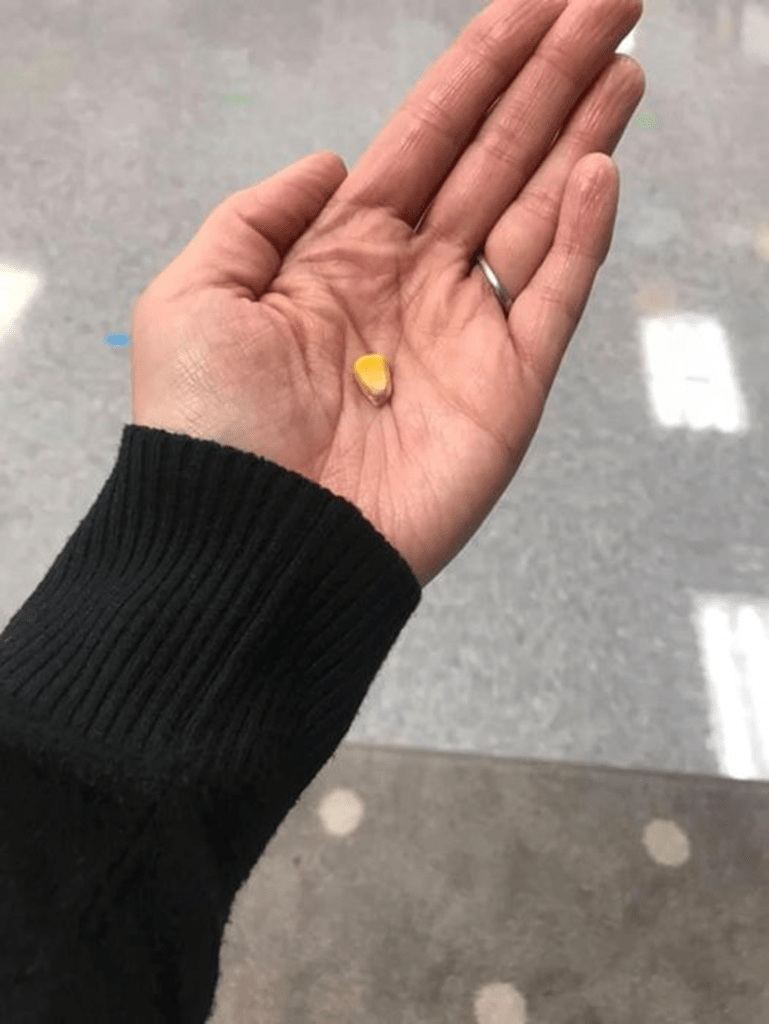
For example, if a student handed this petrified corn kernel to First-Year-Teacher Mrs. Parker, she might have assumed it was trash.
But Seasoned Mrs. Parker realized she should ask for context: “Tell me about this corn kernel.”
Second grader: “I saved it from the Pumpkin Patch. Since you had to stay at school while we went on a field trip.”
Ah. Petrified corn kernel = treasure. I’m glad I stopped to ask.
Have you ever met someone whose actions and attitudes seem totally unexplainable? Maybe they’re belligerent or totally withdrawn. Maybe you observe a situation in which their response doesn’t match the stimulus at all. Whether this happens with students, parents, or even my colleagues, I have realized that when I don’t understand or can’t explain someone’s behavior, it’s because I lack context. More information is needed. And I should proceed with caution before jumping to conclusions. There is almost always more to the story.
For more on Danielson’s domains, check out this link.
 Mrs. Parker's Happy Classroom