Most days in my classroom, effective teaching involves performance art.
I’ve been doing a certain little schtick for years. The objective is to teach the children a simple song called “Hop, Old Squirrel,” a mi-re-do song, so that they can eventually sing it individually and maintain the tonality. (This can take years for some kids, by the way). Step 1 in this process is singing the song several times during each lesson while the children listen. There is literally nothing exciting about this song. Here are the words: “Hop, old squirrel, eidel-dum, eidel-dum. Hop, old squirrel, eidel-dum, dee. Hop, old squirrel, eidel-dum, eidel-dum. Hop, old squirrel, eidel-dum, dee.” For those of you who care about these types of things, the song is a repeated melody, except the first half ends on re (dominant chord), and the second half ends on do (tonic chord).
Thrilling, right?
Of course not. This could be one of the more boring songs in history. But my kids beg me to do it. Guess why?
Because I introduce the concept by telling this story:
“This morning while I was brushing my teeth, I heard a little tap on my window. I pulled the curtains back, and you’ll never guess who I saw there. (I give hints. The children guess…a squirrel.) The squirrel put his little paws up and pressed his nose on the glass. I could tell he wanted me to open the window. So I did. And then he gazed into my eyes and said, “Hey, lady. I heard you’re a teacher. Will you teach me a trick?” So I showed him how to hop. (Insert Hop, Old Squirrel song here, “hopping” my hand along with the steady beat.) But I think he might be back tomorrow, and I’m all out of ideas. Do you know what I could teach the squirrel?”
The kids give great new ideas: run, jump, skateboard, swim, dance, do origami. Whatever. And they listen to me sing the song while they move their own hands to the beat with each new idea. They hear the song multiple times. They’re slightly disappointed when we move on to another activity. Mission accomplished.
Several lessons later, a plot twist: there was no tapping on my window this morning. The kids gasp. Is this the end of Mr. Squirrel?! Why, no! He actually popped out of my backpack halfway to Lone Jack and demanded to drive the minivan, which he did fabulously well. He placed his paws at 10 and 2 and always used his signal. He used the left lane only for passing. And also insisted that we switch the radio to country music.
The children howl with laughter, and then I reach into my backpack and pull out the most perfect Folkmanis squirrel finger puppet. https://www.amazon.com/Folkmanis-Mini-Squirrel-Finger-Puppet/dp/B003ZK9436/ref=sr_1_1?crid=3ERJ5667WZ27Q&keywords=folkmanis+finger+puppet+squirrel&qid=1655430156&sprefix=folkmanis+squirrel+finger+puppet%2Caps%2C96&sr=8-1
This little squirrel will only move if you sing to him. Nearly all the kids take turns teaching him a trick and singing the little song by themselves. Many of them don’t even come close to matching pitch, but that’s okay. The long-term goal is matching pitch. But for those children who haven’t learned to do that at home (news flash: LOTS of kids don’t enter school matching pitch), the short-term goal is just for them to sing at all. So I can assess them. And then I can help them learn.
Over the course of my career, I have taught elementary music, art, and P.E. In each of those disciplines, I have observed that kids who don’t feel confident will struggle to produce something I can assess. Some kids would rather get in trouble for defying the teacher than to truly attempt something scary and fail in front of their classmates. In my English to Speakers of Other Languages (ESOL) training, we studied theorist Stephen Krashen’s concept of the “affective filter.” This is the combination of student attitudes and emotional factors that can negatively impact their ability to learn a new language. Helping English Language Learners (ELLs) to “lower the affective filter” is a crucial part of an ESOL teacher’s job—but really, this is the task for ALL teachers reaching ALL learners.
In my classroom, I have found that puppets (and their stories) have been the single most effective tool for lowering the affective filter. And it’s not just for the cute little kindergarteners. Sometimes the big kids will surprise you.
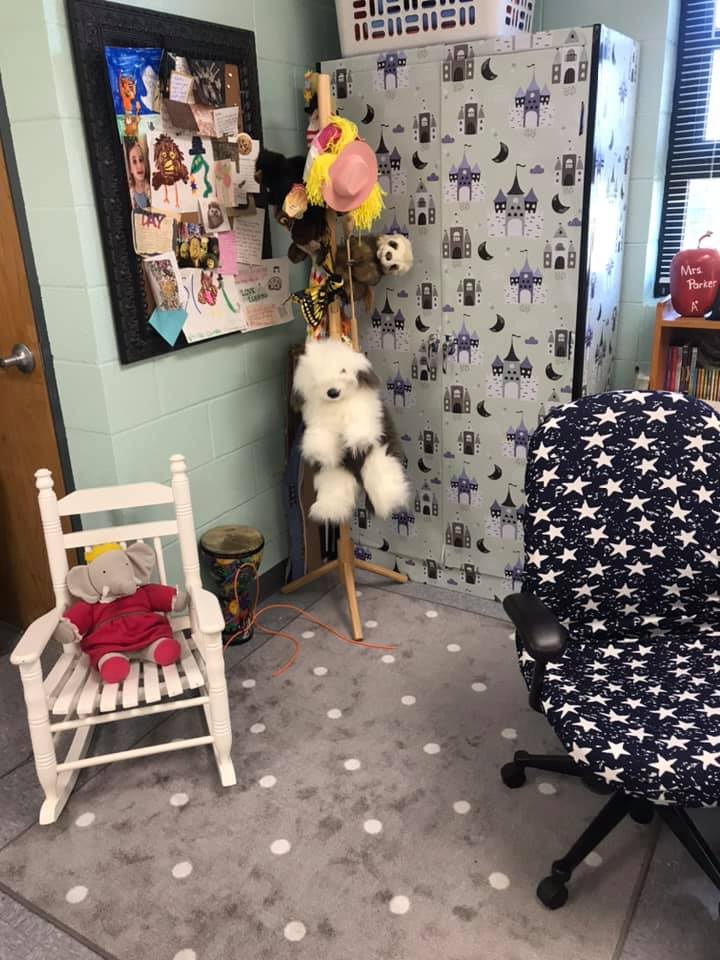
Fifth grader, noticing the enormous sheep dog on the puppet tree: “Hey, can I pet your dog?”
Teacher, coyly: “Which dog do you mean?”
Student, pointing: “That big fluffy one over there.”
Teacher, scoffing: “Don’t be ridiculous. Bingo just plays with the little kids.”
Class, incensed: “What?! That’s not fair!”
Teacher: “Sure it is. You guys are way too old and cool to play with Bingo.”
Class, pleading: “No, we’re not!!”
Teacher, reconsidering: “Well, he won’t come over unless you agree to do things his way.”
Class: “We will! We promise!”
Teacher, cuddling Bingo and making his tail wag happily: “If you insist…he likes it when kids echo his doggy sounds. Don’t you, Bingo?”
Bingo: Artful howling.
Class: Artful howling (a.k.a. vocal exploration, a necessary step toward finding the head voice)
Even the most too-cool-for-school fifth grade boy accidentally snickered out loud when I put Bingo back on the puppet tree and command him to “stay…stay…good boy!”
The strategic use of puppets can make boring things interesting and scary things not-so-scary.
In my next puppet post, I will share how puppets have helped me with behavior challenges and social/emotional learning in the classroom.
*Bingo and I met the day I was supposed to be shopping “only for bulleting board supplies” at Mardel. My poor husband has accepted the fact that the puppet budget is basically limitless at this point. You can get your own glorious Folkmanis sheepdog on Amazon.
 Mrs. Parker's Happy Classroom
2 responses to “Life With Puppets, Part 2: Lower the Affective Filter and Make Boring Jobs Fun!”
Wonderful ideas. I love the affective filter concept.
LikeLike
I watched Mr Rogers with my kids and probably loved it more than they did. His puppets were so alive and I remember watching kids talk with them about things they couldn’t tell real people. And we loved singing with Lambchops too. Love how you’re doing this with your kids!
LikeLike